
.png)




空気循環ファンは本当に機能するのか?2025年に温室の収量を高める3つの実証済みの方法
11月 12, 2025
要旨
制御された温室環境における空気循環ファンの有効性を調査した結果、作物生産を最適化する上で、その基礎的な役割が明らかになった。密閉された農業用構造物内の空気の停滞は、熱成層、局所的な湿度ポケット、葉と大気の界面における二酸化炭素の枯渇といった有害な状態を引き起こす。これらの要因は総体的に植物の成長を阻害し、病原菌の発生を促進し、全体的な収量と品質を低下させる。機械的空気循環の導入は、均質な大気環境を作り出すことで、これらの問題を直接的に軽減する。本研究は、温度を均一化し、相対湿度を管理し、植物キャノピーへのCO2の安定供給を確保することにより、空気循環ファンが単なる付属品ではなく、現代の温室管理にとって不可欠な要素であることを実証している。この分析では、熱力学、植物生理学、農業工学の原理を統合し、空気循環ファンの戦略的導入が、植物の健康を増進し、資源効率を改善し、最終的には世界の多様な気候における温室経営の経済的実行可能性を高める、科学的裏付けのある介入であることを確認している。
要点
- 温室の温度を均一にすることで、ホットスポットとコールドスポットをなくす。
- 植物の葉の結露を防ぐことで、菌類による病気のリスクを減らす。
- 作物に新鮮なCO2を供給することで、光合成を促進します。
- #39;空気循環ファンは本当に効果があるのだろうか?
- 冷暖房システムの効率を高め、エネルギーを節約します。
- 穏やかで一貫した空気の動きにより、植物の茎と構造を強化する。
目次
- 見えない敵:温室内の淀んだ空気を理解する
- 実績ある方法1:一貫した成長のための均一な風土を築く
- 実証済みの方法2:湿度と水分を管理することで植物の健康を強化する
- 実証済みの方法3:ガス交換を最適化することで光合成を最大化する
- 最高のパフォーマンスを発揮するための空気循環ファンの選択、サイジング、配置
- 循環ファンを完全な温室システムに組み込む
- よくある質問(FAQ)
- 結論
- 参考文献
見えない敵:温室内の淀んだ空気を理解する
一見したところ、温室内の空気は静かで、植物を育てるための安らぎの聖域に見えるかもしれない。しかし、この静けさの中には、園芸の成功にとって手強く、しばしば過小評価されがちな敵、「空気の淀み」が潜んでいる。空気の淀みである。この動きの欠如は、作物の可能性を静かに妨害する問題の連鎖を生み出す。この目に見えない課題を理解することは、空気循環ファンが成し遂げる奥深い仕事を理解するための第一歩です。単に空気を動かすのではなく、有害な均衡を崩し、植物が真に成長できる環境を作り出すのだ。この一見穏やかな静寂から生じる3つの主要な脅威を検証してみよう。
閉鎖環境の物理学熱成層と微気候
温室を、太陽の下に置かれた密閉された箱と想像してみてください。太陽のエネルギーは、短波放射の形で、ガラスや高品質の温室用ポリエチレンフィルムなどのグレージングを通過し、内部の表面(土、ベンチ、植物自身)を暖めます。温められた表面は、長波放射として熱を放射し、グレージングに閉じ込められる。これがミニチュアの「温室効果」である。
空気の動きがなければ、物理学の基本原理である対流が起こる。熱い空気は冷たい空気よりも密度が低いため、自然に上昇する。このプロセスは、温室内に温度の明確な層を作り出し、熱成層として知られる現象です。屋根の近くの空気は、植物の高さの空気より5~10℃も高温になります。中東のような暑い気候の生産者にとっては、このピーク時の超高温空気は、トマトやキュウリのような背の高い作物の上部の葉を焦がしてしまう可能性がある。逆に、ロシアの一部や南米の高地のように、夜が寒い地域の生産者にとっては、冷たく密度の高い空気が床に沈み、根系を冷やして成長を阻害する。このような温度勾配は、構造全体に一貫性のない微気候を作り出す。つまり、ある畝の植物は生育が盛んでも、別の畝の植物はストレスを受けている可能性があり、生育にばらつきが生じ、成熟が遅れ、収穫の管理が難しくなる。
生物学的脅威:湿度ポケットがいかに病気を育むか
すべての植物は、自然な呼吸プロセスの一環として、気孔と呼ばれる葉の小さな孔から水蒸気を放出する。このプロセスは蒸散と呼ばれる。静止した環境では、この水蒸気は行き場を失う。水蒸気は植物の周囲に留まり、温室全体の湿度がもっと低くても、100%近い相対湿度の空気の「境界層」を作る。
各植物は、目に見えない小さな湿った毛布に包まれていると考えてほしい。この毛布は、最も壊滅的な温室病害の温床となる。ボトリティス・シネレア(灰色かび病)やうどんこ病のような真菌類は、発芽に常湿を必要とせず、このような高湿度地帯で繁殖します。真菌の胞子は葉に着床し、保護された湿度の高い境界層内で、発芽と植物組織への感染に必要なすべての水分を得ることができる。東南アジアの恒常的に湿度の高い気候の栽培者にとって、これは絶え間ない戦いである。静かで湿度の高い空気は病気の培養器となり、数日のうちに作物のかなりの部分を全滅させることができる。
成長のボトルネック葉面周辺のCO2枯渇
光合成は植物成長のエンジンである。このエンジンを動かすために、植物は太陽光、水、二酸化炭素(CO2)を必要とする。日光と水はよく注意深く管理されるが、葉の表面で利用可能な二酸化炭素は見落とされがちである。植物は気孔を通して大気中の二酸化炭素を「吸い込む」。空気の動きがない場合、植物は葉のすぐ近くにある二酸化炭素をすぐに使い果たしてしまう。
これにより、今度はCO2が欠乏した空気の境界層が形成される。植物の光合成エンジンは、光や水が足りないからではなく、重要な燃料を使い果たしたからだ。密閉されたガレージで車を走らせようとするようなものだ。エンジンはすぐに利用可能な酸素を消費し、エンストしてしまう。いくら肥料を与えても、照明を完璧にしても、植物が十分なCO2にアクセスできなければ、その成長は制限される。このCO2枯渇は、空気循環の悪い温室で樹勢が衰え、収量が低下する主な原因であり、生産性の高い可能性のある環境を劣悪なものにしてしまう。
実績ある方法1:一貫した成長のための均一な風土を築く
空気循環ファンは本当に機能するのか?」という疑問に対する最初の、そして最も明白な答えは、先ほど説明した温度成層を解体する力にある。温室は常に均衡を保とうとするシステムであるが、自然に見出される均衡(上部は暑く、下部は涼しい)は農業にとって有害である。空気循環ファンは積極的な介入であり、床から天井まで、そして隅から隅まで均一な温度という、異なる、より有益な均衡をもたらす道具である。
作用のメカニズム:空気循環ファンによる温度の均一化
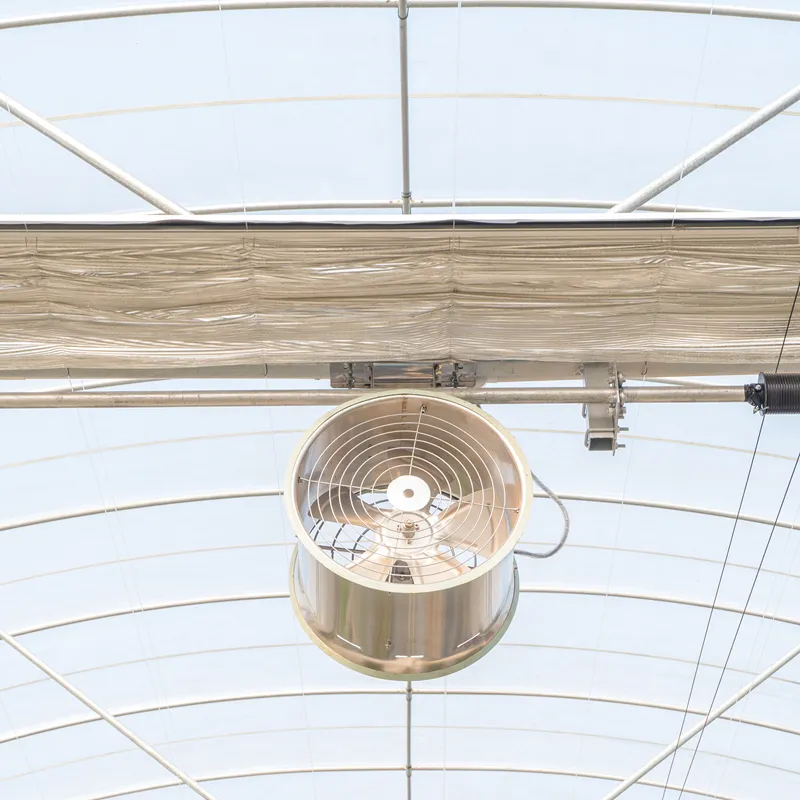
原理はエレガントでシンプルだ。空気循環ファンは、温室全体に穏やかで大規模な空気の動きを作り出すことで機能します。強力で指向性のある風を起こすのではなく、空気全体をゆっくりと一定の動きに保つのだ。熱いブラックコーヒーに冷たいクリームを入れたとしよう。かき混ぜなければ、熱い層と冷たい層ができる。扇風機はスプーンである。空気をかき混ぜて、天井近くまで上昇した熱い空気と、床近くに沈んだ冷たい空気を混ぜ合わせるのだ。
多くの場合、水平気流(HAF)と呼ばれる戦略によって達成されるこの絶え間ない混合は、熱層を破壊する。その結果、温室内のどの2点間の温度差も最小化され、多くの場合1~2℃以下となり、より均質な環境となります。どの植物も、ベンチの位置や高さに関係なく、ほぼ同じ周囲温度を経験する。この均一性が、安定した作物生産の基盤であり、すべての植物が同じ速度で成長・発育することを保証します。
ケーススタディ南アフリカのトマト温室における温度成層化の克服
暑くて乾燥した夏と冷涼で湿気の多い冬で知られる南アフリカの西ケープ州の商業トマト生産者の経験を考えてみよう。この生産者は大きなマルチスパン温室を運営していたが、空気循環を設置する前は一貫して問題に直面していた。夏には、温室のピークに向かって伸びる不定形トマトの株の上部は、葉が丸まったり、結実が悪くなったりと、暑さストレスの兆候が見られたが、株の下部は問題なかった。冬には、彼らは高いコストをかけてヒーターを稼動させなければならなかったが、ヒーターから離れたハウスの端にある株は、やはり寒冷ストレスに苦しみ、成長が遅く、葉が紫色に変色していた。
園芸技術者と相談し、水平送風ファンを導入した。その変化は驚くべきものだった。最初のシーズンで、キャノピー上部の夏の暑さストレスがほとんどなくなったのだ。ファンが山頂の超高温の空気を温室のメインボリュームに戻し、屋根の通気孔でより効果的に管理できるようにしたのだ。冬には、その効果はさらに顕著になった。ファンは、ヒーターによって生成された暖かく浮力のある空気を積極的に植物レベルまで押し下げ、温室の全長にわたって循環させた。その結果、暖房費は15%以上減少した。これは、発生した熱が屋根に無駄に溜まることなく、効率的に利用されたためである。ハウスの端から端まで、果実の大きさや成熟度が一定になり、作物は目に見えて均一になった。
冷暖房効率への影響
南アフリカの事例は、エネルギー節約という重要な経済的利益を強調している。空気循環のない温室を暖房する場合、植物が生育していない温室の上部20%を暖房することになります。植物の高さにあるサーモスタットは、ほんの数メートル上に暖気の貯蔵庫があることに気づかず、より多くの暖房を要求します。循環ファンがこの空気を混合することで、サーモスタットが平均温度を正確に読み取り、生産された熱が最も必要とされる場所、つまり植物のキャノピーに供給される。大学のエクステンション・プログラムによる研究によると、これによって場合によっては20~30%のエネルギー節約につながる(Both et al.)
同じ原理が冷房にも当てはまる。屋根やサイドの換気口による自然換気でも、ファン・アンド・パッド式蒸発式クーラーのような能動的な冷却システムでも、空気の循環によってより効果的になります。ファンによって、冷却された空気が空間全体に均等に行き渡り、高温で淀んだ空気のポケットができるのを防ぎます。これにより、冷却システムはより効率的に働き、より少ないエネルギー消費で希望の設定温度を維持することができます。
熱管理における温室用ポリエチレンフィルムの役割
空気循環の有効性は、温室カバー自体の品質と深く関わっています。最新の高性能 温室用ポリエチレンフィルム は単に光を通すだけではありません。多くのフィルムには熱効果をもたらす添加剤が含まれており、夜間の長波赤外線の放射をより効果的に遮断する。これにより、温室内をより暖かく保つことができます。サーミックフィルムと空気循環システムを組み合わせると、その効果は倍増します。フィルムが熱を閉じ込め、ファンがその閉じ込めた熱を均一に分散させることで、一晩中植物にとって暖かく安定した環境を作り出し、暖房費を大幅に削減します。ウィグルワイヤーチャンネルのような信頼性の高いシステムによってしっかりと固定されたこのフィルムの完全性は、熱管理が可能になる密閉された環境を作り出すために最も重要です。
実証済みの方法2:湿度と水分を管理することで植物の健康を強化する
均一な温度を作り出すことが空気循環ファンの第一の功績だとすれば、第二の功績は湿気を巧みにコントロールすることである。葉の周りの湿度の高い淀んだ境界層は、病害を媒介する主な要因である。穏やかで持続的な空気の動きは、植物を保護するための強力な非化学的手段であり、病原菌が足場を築くことができない環境を作り出す。この機能は、周囲湿度の高さが生産者にとって常に課題となっている地域では特に価値がある。
境界層を破る:蒸発散の科学
境界層の概念をもう一度考えてみよう。境界層とは、すべての葉の表面に付着している静止した空気の微細な層である。植物が蒸散すると、この層は水蒸気で飽和状態になる。空気循環ファンは、この層を常に破壊し、取り除くことで機能する。湿った使用済みの空気を、温室からより新鮮でやや乾燥した空気と入れ替えるのだ。
これには2つの強力な効果がある。第一に、葉の表面の湿度を劇的に下げ、真菌の胞子が発芽しにくい環境を作る。ボトリチスやうどんこ病が発生する条件が満たされないのだ。第二に、飽和空気を除去することで、植物が蒸散を続けるように促す。これは直感に反するように聞こえるかもしれない。と思われるかもしれない。蒸散は、水と溶存栄養素を植物の維管束を通して根から引き上げるエンジンであり、蒸散流として知られるプロセスである。健全な蒸散速度は、健全な養分吸収に直結している。したがって、蒸散を促進することで、空気の循環は、植物を病気から守るだけでなく、より効果的に「養う」のに役立ちます。
| 特徴 | パッシブ湿度コントロール(換気のみ) | アクティブ湿度コントロール(循環ファン+換気) |
|---|---|---|
| メカニズム | 空気の入れ替えを温度/圧力差に頼る。 | 温室内の空気の移動を機械的に強制する。 |
| 効果 | 反応が遅く、穏やかで湿度の高い日には効果がない。 | 境界層の湿度を即時かつ一貫して下げる。 |
| エネルギー使用 | 低い(手動の場合)~中程度(自動ベントの場合)。 | エネルギー消費は控えめだが、一貫性があり予測可能。 |
| 疾病予防 | 限定的。それでも湿度の高い微気候を形成することができる。 | 高い。真菌の発芽条件を積極的に防ぐ。 |
| 均一性 | 通風孔の近くにすきま風が発生し、他の場所には空気が滞留する。 | 均質な環境を作り出し、あらゆる場所の結露を抑える。 |
| 最適 | 乾燥気候または作物密度の低い趣味の温室。 | 商業施設、多湿な気候、高密度の植栽。 |
病気の予防なぜ動く空気はボトリティスとうどんこ病の敵なのか?
病原菌についてもう少し具体的に説明しよう。ボトリティス・シネレア(灰色カビ病)は、美しいイチゴや密生した大麻の花をモヤモヤに変えてしまうことがあるが、これは壊食性真菌である。枯れた組織や弱った組織で繁殖するが、条件が整えば健康な植物にも感染する。ボトリティスにとって「適切」とは、相対湿度が90%を上回り、気温が中程度の状態が数時間続くことを意味する。温室の通路の真ん中にあるセンサーが70% RHと表示しても、停滞した境界層がまさにこの環境を提供する。循環ファンは常に空気を動かすことで、カビが感染を確立するのに必要な高湿度の状態を長時間維持させない。
同様に、うどんこ病は葉に白い埃のような斑点として現れ、キュウリ、カボチャ、バラなどの作物に壊滅的な打撃を与えるが、これも胞子の発芽には高湿度が適している。一旦定着すれば、より乾燥した環境にも耐えられる種もあるが、最初の感染は多くの場合、このような湿度の高い微気候と関係している。空気の移動はこのプロセスを中断させ、発芽の機会を得る前に葉の表面から胞子を物理的に取り除くのにも役立つ。これはシンプルで機械的な防御方法であり、コストのかかる、しばしば予防的な殺菌剤散布の必要性を減らすことができる。
地域の視点:東南アジアと南米における湿度への取り組み
熱帯・亜熱帯地域の生産者にとって、この水分管理の価値はいくら強調してもしすぎることはない。あなたがタイで高価なランを栽培している農家や、コロンビアで切り花を生産している農家だとしよう。日々の最大の課題は暑さではなく、一年中続く圧迫感のある湿度だ。外気も内気と同じように湿度が高いため、換気口を開けてもほとんど効果がないことが多い。このような状況では、室内の空気を外気と交換するだけの換気システムでは不十分です。
ここで、換気と循環の区別が重要になる。換気とは空気の入れ替えであり、循環とは空間内の空気の移動である。湿度の高い気候では、ファンの主な役割は、植物の表面や構造物自体の結露を防ぐために空気を動かすことです。葉の表面を周囲の空気よりわずかに乾燥した状態に保つことで、全体のRHが高くても病気を防ぐことができます。この戦略は、適切な加温と換気(例えば、空気を少し加熱して相対湿度を下げ、その後換気する)と組み合わせることで、熱帯地方で成功する園芸の基礎となります。堅牢な 循環ファン システムは、菌類病原体との日々の戦いにおいて、生産者の最も信頼できるツールとなる。
実証済みの方法3:ガス交換を最適化することで光合成を最大化する
私たちは、空気循環ファンがどのように均一な熱環境を作り出し、より健康的で乾燥した植物キャノピーを作るかを立証しました。3つ目の、そしておそらく最も深い利点は、植物の成長の基本的なプロセスである光合成に直接影響を与えることです。各葉を取り囲む空気の組成を積極的に管理することで、循環扇は光合成の速度を大幅に高めることができ、より速い成長、より大きなバイオマスの蓄積、より高い収量に直接つながります。
CO2プールの補充植物の成長エンジンに燃料を供給する
CO2欠乏境界層の問題に戻ろう。静止した環境では、光合成を行う葉は二酸化炭素の小さな掃除機のようなものだ。葉の表面に最も近い数ミリメートルの空気中の二酸化炭素を素早く排出することができる。この局所的な供給がなくなると、光合成の速度は低下し、光や水によってではなく、新しい二酸化炭素分子のゆっくりとした受動的な拡散によって制限される。
空気循環ファンは、この制限を打ち砕く。温室内の空気全体を緩やかに動かすことで、CO2が枯渇した空気が常に葉から一掃され、通常のCO2濃度(2025年で約400~420ppm)の新鮮な空気と入れ替わる。この絶え間ない補充によって、植物の光合成装置には、炭素を主成分とする燃料が常に十分に供給されることになる。その結果、一日を通して光合成の速度が持続的に高くなる。その結果、光合成の速度が一日中維持され、より多くの糖分が生産され、植物はその糖分を使ってより多くの葉、より強い茎、より大きな果実を作ることができる。CO2エンリッチメント(CO2を温室内に注入し、その濃度を800、1000、さらには1200ppmまで高めること)を実践している生産者にとって、空気循環は有益であるだけでなく、絶対に必要なものである。それがなければ、高価なCO2を注入しても、単に成層化してしまうか、使用されずに放置されるだけで、植物が必要とする気孔に到達することはありません。
換気システムとの相乗効果
空気循環と換気は同じコインの裏表であり、理想的な大気環境を作り出すために一緒に働きます。完全な換気システムには、ギアモーターで駆動する自動ルーフベントやサイドベントなどがあり、外から新鮮な空気を温室内に取り入れる役割を担っています。これは、酸素を補給し、余分な熱と湿度を排出し、新鮮な二酸化炭素を取り入れるために非常に重要です。
しかし、換気システムだけでは問題が生じることもある。換気口付近で隙間風が発生し、温室内の広い面積が淀んだままになってしまうのだ。循環ファンは、換気システムの後を引き継ぎます。換気口から取り込まれた新鮮な空気を、温室全体に均一かつ穏やかに行き渡らせます。換気システムは、新鮮な空気を吸い込む温室の肺と考えてください。循環ファンは、その新鮮な空気の重要な成分を細胞のひとつひとつ、この場合は葉の一枚一枚に運ぶ循環システム(心臓と血管)です。この相乗効果により、新鮮な空気の恩恵が作物全体に均一にもたらされる。
利益の定量化:栄養吸収とバイオマスの増加
最適化されたガス交換の利点は、CO2だけにとどまらない。これまで述べてきたように、良好な空気循環によって促される健全な蒸散は、養分吸収の原動力となる。蒸散がうまくいっている植物は、「水を飲む」こともうまくいっており、土壌や基質から水分や必須マクロおよび微量栄養素を組織内に取り込んでいる。研究により、空気の循環が良好な状態で生育した植物は、静止した空気の中で生育した植物に比べて、より多くの養分を含み、全体的に健全であることが一貫して示されている(Katsoulas et al.)
光合成の強化と栄養吸収の向上が組み合わさることで、バイオマスが測定可能なほど増加する。植物はより早く成長し、構造的により強健になり、収穫量も増える。レタスの栽培者にとっては、1週間早く収穫できたり、15%重い頭を作ることができる。大麻生産者にとっては、花がより密に咲き、貴重な二次代謝産物がより多く含まれるようになる。果実生産者にとっては、1株あたりの果実の数が増え、大きくなる。空気循環ファンは本当に効果があるのか?」という疑問は、空気循環の良い温室とそうでない温室で収穫物の重量を量るだけで、はっきりと肯定的な答えが返ってくる。
最高のパフォーマンスを発揮するための空気循環ファンの選択、サイジング、配置
空気循環ファンが効果的であることを理解することと、最大の効果を得るために正しく導入することは別のことである。目標は、風洞を作ることではなく、穏やかで一貫性のある包括的なパターンの空気の動きを確立することです。適切な選択、サイズ、配置は、この結果を達成し、投資に対するリターンを確保するために最も重要です。
温室に必要な気流(CFM)の計算
最初のステップは、温室の総容積を決めることです。これは簡単な計算です: 温室の容積(立方フィート)=長さ×幅×平均高さ
平均的な高さを使うことを忘れないでください。切妻屋根の温室の場合は、軒までの高さに、軒からピークまでの高さの半分を足した高さになります。クオンセットやアーチ屋根の場合は、中央の高さのおよそ3分の2です。
風量が決まったら、その風量全体を1分間に1~2回動かすのが、効果的な空気循環の一般的な目安です。ファンの能力は立方フィート毎分(CFM)で測定されます。従って、温室に必要な総CFMは次のようになります: 必要総CFM=温室容積×(1~2)
例えば、幅30フィート、長さ100フィート、平均高さ12フィートの温室の容積は36,000立方フィートである。 30' × 100' × 12' = 36,000立方フィート。 この体積を1分間に2回動かすには、ファンの総容量が必要となる: 36,000 × 2 = 72,000 cfm
次に、この合計CFMを使用予定の個々のファンの定格CFMで割って、必要なファンの数を決定します。各定格が4,000 CFMのファンを選んだ場合、その温室には72,000÷4,000=18台のファンが必要です。
| ファンの配置戦略 | 説明 | 長所 | 短所 | こんな方に最適 |
|---|---|---|---|---|
| 水平エアフロー(HAF) | ファンは作物の上に置かれ、温室の片側を下降し、もう片側を上昇する円形の「レーストラック」パターンの空気の動きを作り出す。 | Highly effective at mixing air, creating uniform temperature and humidity. Well-studied and reliable. | Requires careful placement to avoid blockages. May not be ideal for very tall, dense canopies. | Most standard greenhouse layouts for vegetable, flower, and nursery crops. |
| Vertical Air Flow (VAF) | Fans are placed above the canopy, pulling air from the top and pushing it down into the plant canopy, where it then spreads outwards and rises up the sides. | Excellent at penetrating dense canopies. Directly targets the plant microclimate. Can reduce energy use. | Newer concept, can be more complex to design. May require specialized fans. | High-density crops like cannabis, or vertical farms. |
Strategic Placement for Optimal Circulation Patterns
Simply having the right number of fans is not enough; they must be placed correctly to work as a system. The most common and effective method is the Horizontal Air Flow (HAF) pattern.
Imagine your greenhouse is a racetrack. You will place two lines of fans, one on each side of the house. On one side, all the fans will point in one direction (e.g., toward the back of the greenhouse). On the other side, all the fans will point in the opposite direction (toward the front). This setup creates a large, slow-moving, circular rotation of the entire air mass.
Key placement rules for HAF:
- 高さ: Position the fans just above the mature height of your crop to prevent direct blowing that can damage plants.
- 文字間隔: Space the fans no more than 40-50 times their blade diameter apart. For a 20-inch fan, this means a maximum spacing of about 65-80 feet, though closer is often better.
- Aim: Do not aim the fans down at the plants. They should be aimed straight ahead, parallel to the floor, to create the horizontal air movement. The air should be moving above and between the plants, not directly at them.
- Obstructions: Ensure there are no major obstructions, like hanging equipment or posts, that would break the circular airflow pattern.
Horizontal Airflow (HAF) vs. Vertical Airflow (VAF): A Comparative Analysis
While HAF is the industry standard, a newer concept, Vertical Air Flow (VAF), is gaining traction, particularly for specific applications. VAF systems use fans to pull air from above the canopy and push it downwards into the plants. This directly targets the humid, CO2-depleted microclimate within the canopy. The air then moves outwards towards the aisles and rises back up, creating a different kind of circulation pattern.
The choice between HAF and VAF depends on your crop and greenhouse structure. HAF is a proven, robust method for general temperature and humidity homogenization in most standard greenhouse setups. VAF can be particularly effective for very dense canopies where horizontal air movement struggles to penetrate, such as in high-density cannabis cultivation or with leafy greens. Some growers are even experimenting with hybrid systems that use both HAF and VAF principles to maximize the benefits of each.
The Importance of a Reliable Gear Motor in Fan Performance
While we are discussing fans, it is worth noting the quality of the components. A circulation fan is only as good as its motor. A high-quality, durable motor will ensure consistent performance, energy efficiency, and a long operational life. This principle extends to the entire greenhouse automation system. For example, the gear motor that operates your automated vents is just as important. A reliable gear motor ensures that your ventilation system works in perfect harmony with your circulation fans, opening and closing smoothly to maintain the desired environment. Investing in quality components across the board, from fan motors to vent actuators, prevents system failures that can have catastrophic consequences for a crop.
循環ファンを完全な温室システムに組み込む
An air circulation fan does not operate in a vacuum. Its true power is unlocked when it is viewed and implemented as an integral part of a complete, holistic greenhouse environmental management system. Its performance is influenced by the structure of the greenhouse itself, its synergy with automation systems, and a commitment to proper maintenance.
The Relationship with Wiggle Wire and Poly Film Installation
The very concept of controlled environment agriculture rests on the integrity of the barrier between the inside and the outside. This barrier is your greenhouse covering, typically a polyethylene film. For a circulation system to be effective, especially for temperature and humidity management, the greenhouse must be reasonably well-sealed. Air leaks are the enemy of efficiency.
This is where the quality of your film installation becomes critical. A system using wiggle wire and a corresponding wiggle wire channel provides a continuous, secure grip on the poly film, creating a tight seal along every purlin, hip board, and baseboard. Unlike systems that use staples or battens, which create pressure points and potential tear spots, the gentle, undulating pressure of a wiggle wire distributes the load evenly. This secure seal prevents unwanted air exchange, stopping your carefully heated and circulated air from leaking out and preventing cold drafts from coming in. A well-sealed greenhouse, made possible by a quality film and attachment system, is the foundation upon which an efficient air circulation strategy is built.
Automating for Efficiency: Connecting Fans to Environmental Controllers
In the 21st century, running a commercial greenhouse efficiently means embracing automation. Air circulation fans should not simply be turned on and left to run 24/7. Their operation should be intelligent and responsive to the changing conditions within the greenhouse. This is achieved by connecting them to an integrated environmental controller.
A good controller can be programmed to operate the fans based on a variety of inputs:
- Thermostats: Fans can be set to turn on automatically when the temperature differential between two sensors (e.g., one at the floor and one at the peak) exceeds a certain threshold, for instance, 2°C. This directly combats thermal stratification.
- Humidistats: Fans can be programmed to run in conjunction with the ventilation system when relative humidity rises above a target setpoint, actively working to dry the plant canopy and prevent disease.
- Timers: At a minimum, fans can be run on a cycle (e.g., 15 minutes on, 15 minutes off) during periods of low light when transpiration and CO2 demand are lower, saving energy while still preventing stagnation.
- CO2 Sensors: In highly advanced systems, fan speed and operation can be linked to CO2 levels, ensuring that enriched air is being effectively distributed.
By automating your fans, you move from a brute-force approach to a nuanced, energy-efficient strategy that applies air movement precisely when and where it is needed most.
Maintenance and Longevity: Ensuring Your Investment Lasts
Like any piece of mechanical equipment, air circulation fans require periodic maintenance to perform at their best and to ensure a long service life. A neglected fan can become inefficient, noisy, and even a safety hazard. A simple maintenance schedule should be a part of any greenhouse management plan.
Key maintenance tasks include:
- Cleaning: Fan blades and safety guards will accumulate dust and debris. This buildup reduces airflow and can unbalance the blades, putting stress on the motor. Clean them at least once or twice a year with a brush or compressed air.
- Inspection: Regularly inspect the fan mounts to ensure they are secure. Check power cords for any signs of fraying or damage.
- Lubrication: Some fan motors have lubrication ports that require a few drops of oil annually. Check the manufacturer's instructions for your specific model. Many modern fan motors are sealed and do not require lubrication.
- Belt Tension: For belt-driven fans, check the belt for wear and proper tension. A loose belt will slip and reduce performance, while a belt that is too tight will cause premature wear on the motor and bearings.
A few hours dedicated to maintenance each year will protect your investment, ensure your fans operate at peak efficiency, and maintain the optimal growing environment you have worked so hard to create.
よくある質問(FAQ)
1. Will an air circulation fan make my greenhouse too cold for my plants? No, this is a common misconception. An air circulation fan does not cool the air in the way an air conditioner does. It simply moves and mixes the existing air. By distributing the warm air that collects at the ceiling, it can actually make the plant canopy warmer, especially during the night or in winter. The feeling of "coolness" is the wind chill effect on human skin, but the actual air temperature becomes more uniform.
2. How much electricity does a greenhouse circulation fan use? The energy consumption depends on the size and efficiency of the fan's motor, but most modern circulation fans are highly efficient. A typical 20-inch (50cm) basket fan might use between 100 and 250 watts. While this does add to your electricity bill, the cost is often completely offset by the savings in heating costs and the economic losses prevented from disease and poor growth.
3. Can I just use one big fan at the end of the greenhouse? This is generally not an effective strategy. One large fan will create a jet of fast-moving air in one area and leave the rest of the greenhouse stagnant. It creates a "wind tunnel" rather than the gentle, whole-volume air rotation that is desired. A system of multiple, smaller, strategically placed fans is far more effective at creating a uniform environment.
4. Do I need to run my circulation fans 24/7? Not necessarily. While continuous operation is the simplest strategy, it is often more energy-efficient to connect the fans to an environmental controller. This allows them to run only when needed, for example, when the temperature difference between the roof and floor is too great, or when humidity levels are high. However, even running them on a simple timer (e.g., on for 30 minutes, off for 30 minutes) is better than no circulation at all.
5. My greenhouse has side vents that I can roll up. Do I still need circulation fans? Yes. Roll-up sides, often managed with a film reeler, are an excellent component of a natural ventilation system. They are great for letting out large amounts of heat and exchanging air on breezy days. However, on calm, still days, or when the vents are closed at night, the air inside will become stagnant. Circulation fans work with your ventilation system, distributing the fresh air that the vents let in and keeping the air moving when the vents are closed.
6. Can the air movement from a fan damage my plants? If the fan is too powerful or aimed directly at the plants from close range, it can cause physical damage (wind burn) or stress. This is why proper placement and sizing are so important. The goal of HAF is to create a gentle air speed of 2-3 feet per second (0.6-0.9 m/s) around the plants, which is similar to a light breeze. This level of movement is not only safe but is actually beneficial, helping to strengthen plant stems.
7. Does an air circulation fan help with insect control? It can have a minor, indirect effect. The air movement can make it more difficult for small flying insects like fungus gnats, thrips, and whiteflies to fly and land on plants. However, it is not a primary or reliable method of pest control and should not replace proper integrated pest management (IPM) strategies.
結論
The question of whether an air circulation fan truly works within a greenhouse environment can be met with a decisive and scientifically supported affirmation. The seemingly simple act of moving air addresses a trifecta of fundamental challenges inherent to enclosed agriculture. It systematically dismantles thermal stratification, forging a uniform climate that promotes consistent and predictable crop development. It actively manages moisture at the most critical location—the leaf surface—fortifying plants against the constant threat of devastating fungal diseases. And it replenishes the vital carbon dioxide needed for photosynthesis, directly fueling plant growth and maximizing the genetic potential of the crop.
For the modern grower, whether tending to roses in South Africa, tomatoes in the Middle East, or orchids in Southeast Asia, the air circulation fan transcends its status as a mere piece of equipment. It is a sophisticated tool for environmental modification, an investment in risk management, and a direct driver of profitability. When selected with care, placed with strategy, and integrated into a holistic system of environmental control, the circulation fan becomes an indispensable partner, working silently and ceaselessly to transform a static space into a dynamic, healthy, and highly productive ecosystem.
参考文献
Both, A. J., Reiss, E., & Krogmann, U. (2017). Energy consumption in a commercial greenhouse. Rutgers University, New Jersey Agricultural Experiment Station. Retrieved from https://njaes.rutgers.edu/pubs/fs1331/
Jay, O., & Kenny, G. P. (2024). A critical review of the effectiveness of electric fans as a personal cooling intervention in hot weather and heatwaves. The Lancet Planetary Health, 8(4), e250-e260. (24)00030-5
Katsoulas, N., Kittas, C., Dimokas, G., & Lykas, C. (2006). Effect of vent opening and insect screen on greenhouse ventilation. Biosystems Engineering, 93(4), 427-436.
Sanford, S. (2011). Reducing heating costs in poly-covered greenhouses. University of Wisconsin-Extension. Retrieved from
Sase, S., & Christianson, L. L. (1990). Air circulation systems in greenhouses. In International Winter Meeting of the American Society of Agricultural Engineers. American Society of Agricultural and Biological Engineers. https://elibrary.asabe.org/abstract.asp?aid=31998
Teitel, M., & Tanny, J. (1999). Natural ventilation of greenhouses: experiments and model. Agricultural and Forest Meteorology, 96(1-3), 59-70. (99)00057-5
Valera, D. L., Belmonte, L. J., Molina, F. D., & López, A. (2016). Greenhouse agriculture in Almería. A comprehensive techno-economic analysis. Ed. Cajamar Caja Rural, 1-408. Retrieved from